
- Offizieller Beitrag
Disclaimer: In diesem Strang geht es um die Verwendung der OGL für die Publikation von Rollenspielmaterial. Es geht nicht um die aktuelle Rechtesituation im Bereich cthuloider Systeme (anderes Thema).
Was ist die OGL?
Die Open Game License (OGL) gehört zu den Open-Content-Lizenzen, erlaubt also die freie Verwertung der ihr unterstellten Werke. In dieser Hinsicht ähnelt sie der GPL und wurde auch von deren Idee der free software inspiriert.
Sie wurde von Wizards of the Coast (WotC) erstellt, um den Vertrieb von Zusatzbüchern zu ihrem Rollenspiel Dungeons & Dragons zu erleichtern, vor allem um ihr Regelwerk auch in Bereichen präsent zu halten, die für WotC selbst nicht lukrativ genug erscheinen. Nicht zu verwechseln ist die OGL mit der d20 license, die die Benutzung der Marke d20 auf eigenen Werken gestattet.
(Quelle: https://de.wikipedia.org/wiki/Open_Game_License)
Die OGL unterscheidet zwei Bereiche.
Open Game Content (or OGC)
...the game mechanic and includes the methods, procedures, processes and routines to the extent such content does not embody the Product Identity and is an enhancement over the prior art and any additional content clearly identified as Open Game Content by the Contributor, and means any work covered by this License, including translations and derivative works under copyright law, but specifically excludes Product Identity....
Product Identity (or PI)
...product and product line names, logos and identifying marks including trade dress; artifacts; creatures characters; stories, storylines, plots, thematic elements, dialogue, incidents, language, artwork, symbols, designs, depictions, likenesses, formats, poses, concepts, themes and graphic, photographic and other visual or audio representations; names and descriptions of characters, spells, enchantments, personalities, teams, personas, likenesses and special abilities; places, locations, environments, creatures, equipment, magical or supernatural abilities or effects, logos, symbols, or graphic designs; and any other trademark or registered trademark...
(Quelle: https://en.wikipedia.org/wiki/Open_Game_License)
Wie nutzt man die OGL?
By attaching this license game developers allow the use of their OGC and any additional content they may have indicated to be OGC. This use is perpetual, worldwide, royalty-free, and non-exclusive as long as the use is accompanied by a copy of the OGL with all the Copyrights updated to credit the contributors of all OGC that was used. All used OGC is to be indicated with a notice.
Licensees are prevented from distributing, copying, or modifying PI, and may not use the contributor's name for the purposes of marketing or advertising, unless permission is acquired through a separate license or agreement with the holders of the PI.
Finally, the OGL requires attribution be maintained by the copying of all copyright notices from OGC a licensee is copying, modifying or distributing. This requires that the license notice itself must be altered by adding all copyright notices to the Section 15 part of the license.
Wie sieht die OGL aus?
http://www.opengamingfoundation.org/ogl.html
Wie sieht das in der Praxis aus?
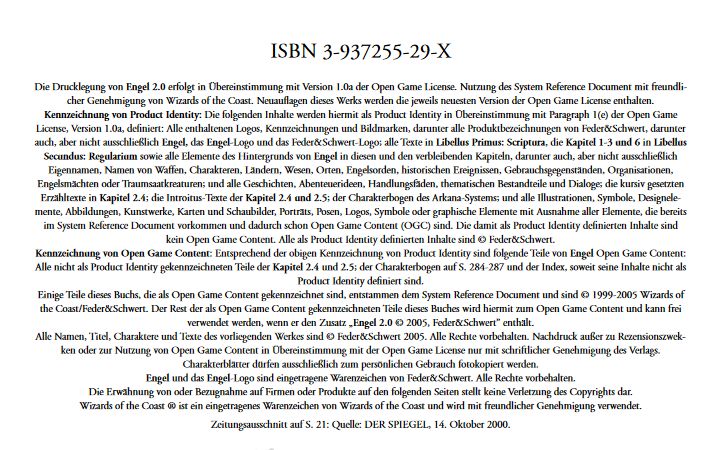
Beispiel: Delta Green - Agents Handbook
Auf S. 190 ist die OGL abgedruckt. Dazu kommen zwei Paragraphen:
PRODUCT IDENTITY:The following
items are hereby identified as Product
Identity, as defined in the Open Gaming
License Version 1.0a, Section 1(e), and are
not Open Game Content: the intellectual
property known as Delta Green; all
trademarks, proper names, artwork, and
trade dress; and all text not explicitly
identified as Open Game Content.
Hinzu kommt
OPEN GAME CONTENT:The following
items are hereby designated as Open
Gaming Content under the terms of the
Open Game License Version 1.0a, Section
1(d): game mechanics on pages 14–22,
28–36, 42–47, 50–63, 66–75, 78–79, and
84–95.
Das bedeutet also, dass man auf Basis der auf den angegebenen Seiten enthaltenen Regelmechaniken bspw. ein Abenteuer schreiben darf. Dieses darf aber z. B. nicht mit "Hey, ein Delta Green Abenteuer" beworben werden. Genauso wenig dürfte man entsprechende andere lizenzbehaftete Wörter oder Begriffe benutzen (sprich: Cthulhu oder das Ältere Zeichen als Bild). Aber das ist ein anderes Thema.
Zum anderen verstehe ich es so, dass man keine Erlaubnis benötigt und zudem die Publikation auch gegen Geld anbieten darf.

 Fühlt sich mal einfach jeder an dieser Diskussion beteiligte geliked, bitte.